English
 Français
 Deutsch
 Spanish
 Italian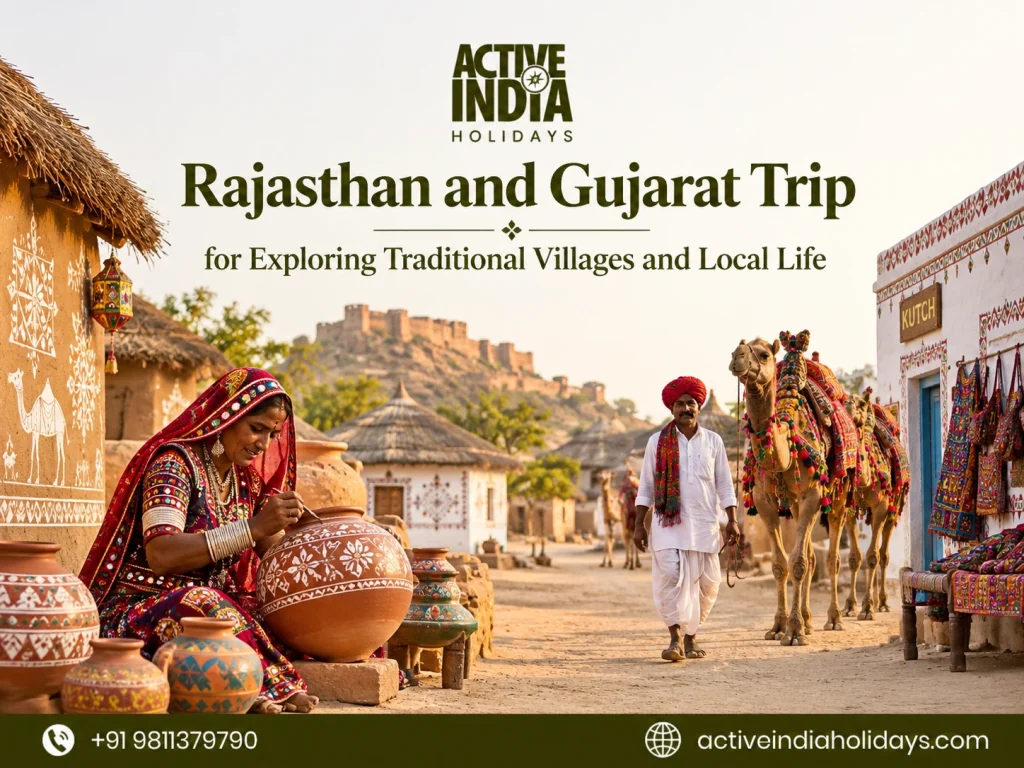
Everyone plans their Rajasthan trip around the big three — Jaipur, Udaipur, Jodhpur. And fair enough, these cities are stunning. But some of our best trips at Active India Holidays have happened once we left the cities behind and drove into the villages nobody puts on their itinerary. That’s where this Rajasthan and Gujarat trip comes from — years of taking people down dusty roads to places where life hasn’t really changed in decades.
We’re not talking about a quick photo-stop village visit either. This is sitting on a charpai with a farmer’s family, drinking chai that’s way too sweet, and realizing that this, honestly, is the part of the trip people remember the most. Not the forts. The people.
Forts Tell You About Kings. Villages Tell You About People.
We’ve taken guests to the Bishnoi villages just outside Jodhpur more times than we can count, and it never gets old. You’ll see a potter working clay the exact way his father taught him, a woman weaving on a handloom that’s probably older than her own grandmother, and blackbucks casually grazing next to someone’s wheat field like it’s completely normal — which, out there, it is.
Cross over into Gujarat and Kutch is where things really shift gears. The Rabari and Ahir communities here have been doing embroidery, mirror work, and block printing for generations, and they’re happy to show you how it’s done if you’re curious. Walk through a village near Bhuj and you’ll probably see fabric being dyed in bright indigo right there on the ground, kids running around in tiny mirrored skirts, and someone’s grandfather explaining a craft he’s been doing since before India got independence.
A Rough Idea of How the Trip Runs
We keep this trip slow on purpose — rushing through villages kind of misses the point.
Starting from Jaipur, we head into Shekhawati first, stopping in Mandawa and Nawalgarh where entire havelis are covered top to bottom in old frescoes. From there it’s Jodhpur, and a morning spent with the Bishnoi community. Then we move through the quieter farming belt around Luni, where camel carts still outnumber cars and old step-wells are used the same way they were a hundred years ago.
After that, we cross into Kutch — the White Rann, the salt villages, and craft towns like Nirona for lacquer work, Bhujodi for weaving, and Ajrakhpur for block printing. If timing allows, we also swing by the Little Rann, home to the Agariya salt workers, and if you’re lucky, you’ll spot a wild ass or two out on the flats.
Every single stop is built around actually talking to people. Sharing food, watching someone work, sitting around even when there’s a language barrier and half the conversation is just smiling and pointing.
Honestly, the Food Might Be the Best Part
Village food out here is nothing like the restaurant version back in the cities. In rural Rajasthan you’re getting dal-baati-churma cooked slow over a wood fire, bajra rotis, whatever vegetables happened to grow that season. In Gujarat’s villages it’s thepla, khichdi, and buttermilk that actually tastes like it came from a cow that morning — because it did. Meals happen on the floor, served by the same family that grew half of what’s on your plate.
When to Go
October through March is the sweet spot. Weather stays cool enough that you can actually walk around villages without melting, which matters more than people expect. If you can time it with Rann Utsav in winter, you get desert camping, folk music, and village exploring all in one go.
This Trip Works for More People Than You’d Think
We get asked a lot whether this fits different kinds of travellers, and it usually does.
If adventure holidays in India are more your thing, we can easily throw in a camel safari, a jeep run across the Rann, or a short trek near the Aravallis along the way. Families looking for family holidays in India tend to like this route a lot too — the pace is easy, stays are simple homestays or small heritage places, and kids genuinely get into the craft demos in a way they don’t with, say, a museum.
We’ve also had a few groups cycle through the flatter parts of rural Gujarat, and it’s a really peaceful way to see village life up close. If you’re after cycling holidays in India that aren’t all mountain climbs, this route works surprisingly well.
A lot of our travellers also ask about combining regions. If slow, community-focused travel is your thing, our central India holidays itineraries through Madhya Pradesh’s tribal belts follow the same idea — real villages, real people, no crowds. And for anyone who wants to see a completely different side of village India, our north east India tour packages take you into Nagaland’s hill villages and Assam’s tea estates, which honestly feel like a whole different country.
A Few Things Worth Knowing Before You Go
Carry cash in small notes — most villages don’t take cards. Dress a bit modestly, especially when you’re inside someone’s home. Ask before you photograph people, particularly women and older folks. Nights get colder than you’d expect in the desert, even outside peak winter, so pack a layer. And honestly, keep your schedule loose — some of the best moments on this trip happen when you decide to just stay an extra hour somewhere.
A Few Questions People Usually Ask Us
How many days should I plan for this?
10 to 12 days is a good length if you want to actually experience both regions without feeling rushed.
Is it safe for solo female travellers?
Yes, especially with a proper guide and pre-arranged homestays. Village communities out here are generally very welcoming to visitors.
What language will I hear in these villages?
Marwari and Rajasthani dialects in Rajasthan, Gujarati or Kutchi in Gujarat. Your guide handles the translation side of things.
Can I combine this with other parts of India?
Definitely — a good number of our travellers add on our central India holidays or extend into our north east India tour packages for a longer, more varied trip.
Is this trip adventurous enough, or is it mostly cultural?
Both, really. You can pair it with desert camping, jeep safaris, and light cycling, so it works well even if you’re mainly looking for adventure holidays in India.
If wandering through real villages, eating home-cooked food, and talking to people who’ve lived this way for generations sounds like your kind of trip, get in touch with us at Active India Holidays — we’ll build the route around what you actually want to see.