

 English
 Français
 Deutsch
 Spanish
 Italian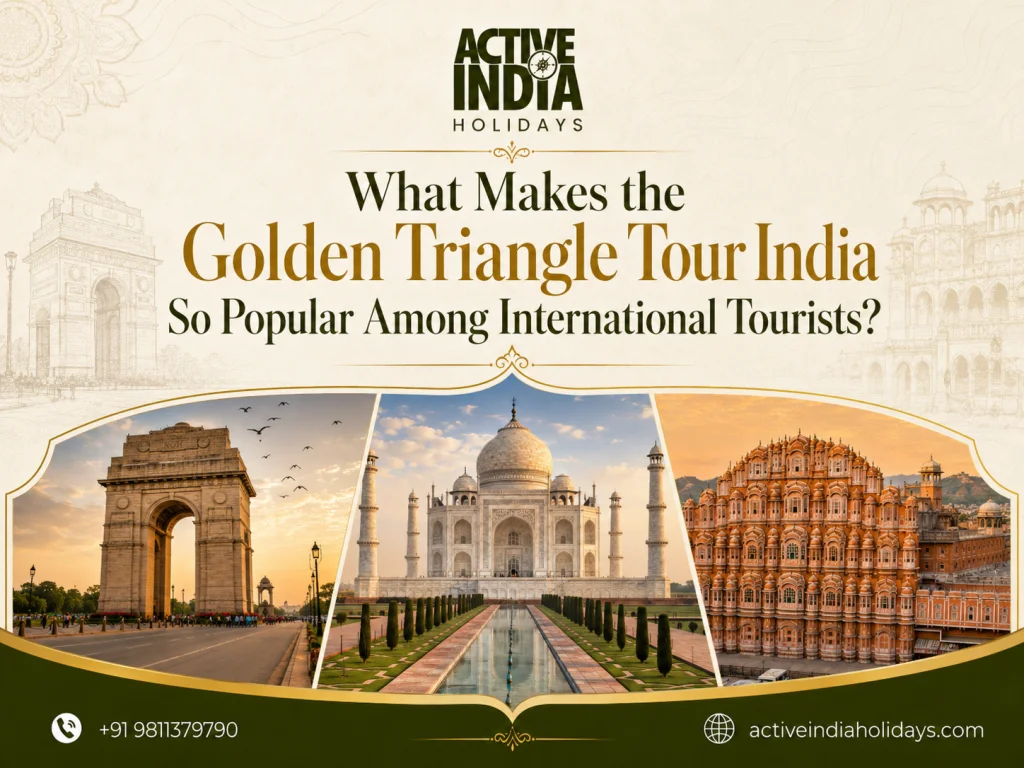
Every year, millions of travellers fly into India with a list of places they want to see before they leave. And almost every time, the same three cities make it to the top of that list — Delhi, Agra, and Jaipur. This route has become so well-known around the world that it now has its own name: the Golden Triangle tour India. But what exactly makes this particular journey so special? Why do first-time visitors keep choosing it over everything else India has to offer?
The answer is simple. These three cities together tell the story of India better than any guidebook ever could. The history, the food, the architecture, the people — it all comes together in a way that leaves most travellers wanting to come back and see more. And for those who want to experience this journey without the stress of planning everything from scratch, Active India Holidays has been putting together Golden Triangle itineraries that feel personal, not packaged.
Three Cities, Three Completely Different Worlds
One of the biggest reasons the Golden Triangle tour India works so well is the contrast. Each city feels completely different from the other two, yet they all connect in a way that makes perfect sense when you travel between them.
Delhi is where most international tourists land. It is loud, layered, and full of history. You can walk through narrow lanes in Old Delhi where spice merchants have been sitting in the same spot for generations, and then drive twenty minutes to Connaught Place, which looks and feels like a completely modern city. Delhi has Mughal monuments, colonial architecture, street food that changes every hundred metres, and a pace of life that takes a little getting used to — but once it does, it stays with you. Humayun’s Tomb, Qutub Minar, the Red Fort, Jama Masjid — the list of things worth seeing in Delhi alone could fill an entire trip.
Agra is where the Taj Mahal is, and there is really nothing more to say about that. Seeing it in person, especially at sunrise when the light hits the white marble just right, is one of those experiences that people genuinely struggle to describe. Photographs do not do it justice. The Taj Mahal is the centrepiece of any delhi agra jaipur tour package, and rightfully so. But Agra also has Agra Fort, which is massive and often underestimated, and Fatehpur Sikri nearby — a ghost city built by Emperor Akbar that was abandoned shortly after it was completed. Both deserve more attention than they usually get from visitors who are rushing to and from the main monument.
Jaipur closes the triangle, and it does so with a personality that is entirely its own. The Pink City — as it is called because of the rose-coloured buildings in the old part of town — has a warmth and a character that tourists tend to fall in love with quickly. Amber Fort sitting up on a hill overlooking a lake, Hawa Mahal with its hundreds of small windows built so royal women could watch street life without being seen, and the colourful chaos of Johari Bazaar all come together to make Jaipur feel like a place out of a travel magazine. Except you are actually standing in it, eating kachori from a street stall and bargaining for block-printed fabric.
A Route That Actually Makes Sense
One thing that international tourists genuinely appreciate about golden triangle india holidays is that the logistics are easy. The three cities form a rough triangle in northern India, and the distances between them are manageable. Delhi to Agra is about 200 kilometres, Agra to Jaipur is around 240 kilometres, and Jaipur back to Delhi is roughly 270 kilometres. You can do the whole route by road, by train, or a combination of both depending on how much time you have and how you prefer to travel.
For someone visiting India for the first time, this matters a lot. India is a vast country, and figuring out how to get from one place to another can feel overwhelming before you arrive. The Golden Triangle takes that stress away. You have a clear starting point, a clear route, and a clear ending point. Everything in between is the good part. At Active India Holidays, the entire route is planned keeping first-time visitors in mind — so you always know where you are going next and what to expect when you get there.
It Works for Almost Every Kind of Traveller
Another reason the Golden Triangle tour India has stayed popular for so long is that it genuinely works for almost everyone. It is one of the best routes for family holidays in India because there is something for every age group. Children are fascinated by the forts, the elephant stories, and the sheer size of the monuments. Adults are drawn to the architecture, the history, and the local markets. Older travellers appreciate that the cities are well connected, that the roads between them are good, and that quality accommodation exists at every price point.
Couples find it romantic in a way that is hard to put into words — there is something about watching the sun rise over the Taj Mahal together that tends to stay with people for a long time. Solo travellers find it safe, well-touristed, and easy to navigate even without a guide. The Golden Triangle is one of those rare routes that genuinely does not exclude anyone.
There Is More Adventure Here Than People Expect
The Golden Triangle is not just about standing in front of monuments and taking photographs, though there is plenty of that too. Jaipur has hot air balloon rides that take you up over the city at dawn, with Amber Fort visible below and the Aravalli hills stretching out in the distance. You can take a cooking class in Delhi and spend a morning learning how to make dal makhani and butter chicken from someone who has been cooking it their whole life. Agra has cycle rickshaw tours through the old city that take you into lanes most tourists never find on their own.
For travellers who want something more active alongside the history, the golden triangle tour itinerary can easily be shaped around those interests. It is one of the reasons this route appeals to such a wide range of people.
The Food Alone Is Worth the Trip
International tourists are often genuinely surprised by how different the food tastes across three cities that are all in the same region. Delhi is famous for its street food — chole bhature in the morning, parathas dripping with butter from Paranthe Wali Gali, seekh kebabs from Karim’s in Old Delhi that have been slow-cooked the same way for over a hundred years. Agra has its own specialities, including a sweet called petha made from ash gourd that locals wrap up and take home as gifts. Jaipur brings bold Rajasthani flavours into the picture — dal baati churma, laal maas, and sweets like ghevar that you are unlikely to find anywhere else in quite the same form.
For anyone who loves food, moving through these three cities is like doing a proper tasting tour of North Indian cuisine without having to plan anything complicated.
History That You Can Actually Feel
What separates the Golden Triangle tour India from a history lesson is the fact that you are walking through the actual spaces where things happened. Standing inside Diwan-i-Khas at Agra Fort, where Mughal emperors once held court, does something to you that reading about it simply cannot. Climbing up to Amber Fort and looking out over Jaipur from the top makes you understand immediately why it was built exactly where it was. These are not reconstructions or replicas. They are the real thing, standing exactly where they have been standing for hundreds of years.
Why Travellers Keep Coming Back to This Route
Trends in travel change constantly. New destinations become popular, old ones fade out. But the Golden Triangle tour India has been drawing international tourists to these three cities for decades, and it continues to do so because it delivers exactly what it promises — history, colour, food, culture, and a version of India that feels full and complete even if you only have a week to spare.
If you are planning your first trip to India and are not sure where to begin, this is the route that has answered that question for travellers coming from every corner of the world. Active India Holidays can help you put together a Golden Triangle itinerary that fits your travel style, your budget, and the kind of experience you are actually looking for — not a rushed standard tour, but something that gives you enough time in each city to actually feel like you were there.


